
The year isn’t over yet, but Free League has already created one of the best RPG systems to date. The Electric State RPG boasts the best world I’ve encountered among games using the Year Zero Engine and excels at translating tabletop roles into mechanical elements. Let’s start with the conclusion: Electric State RPG has already become my favorite game of the year. From the day it was announced, I followed its Kickstarter campaign and had the opportunity to test its beta version. Normally, I would write a review as soon as I played the beta, but for such a good RPG, I wanted to wait for the full version and run a few games.
To test the game, I set up a table at the TTRPG event “Gray City Stories” and played with newcomers to the TTRPG hobby. Afterward, I played with experienced TTRPG Players in my close circle. Both sessions yielded surprisingly incredible results. The game, with Simon Stålenhag‘s unique world and its support for role-playing with mechanical elements, quickly captivates both new and experienced players.
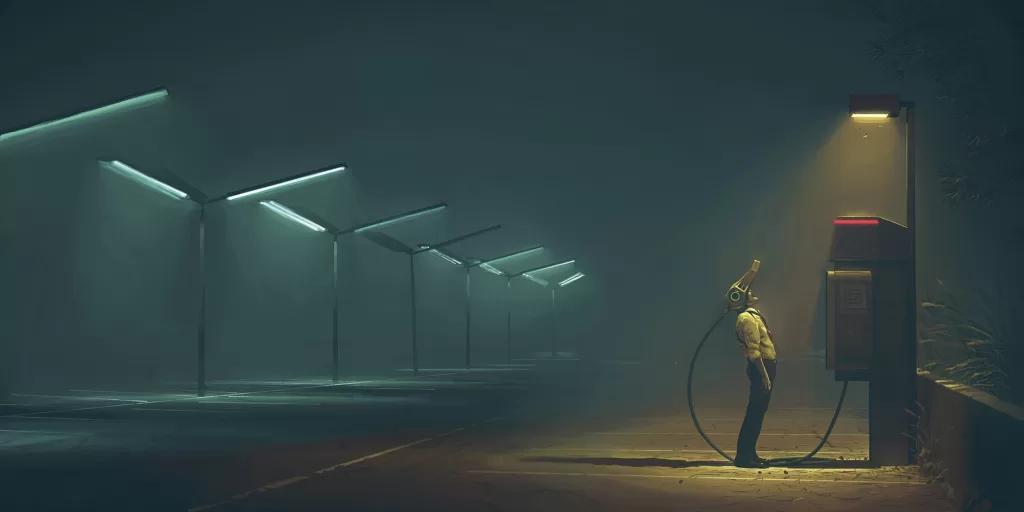
As you might gather from the start, Electric State is a system adapted by Free League from Simon Stålenhag’s book of the same name. Those who have read the book already know about Electric State’s unique world, but let’s briefly explain it for those who haven’t.
The World of Electric State
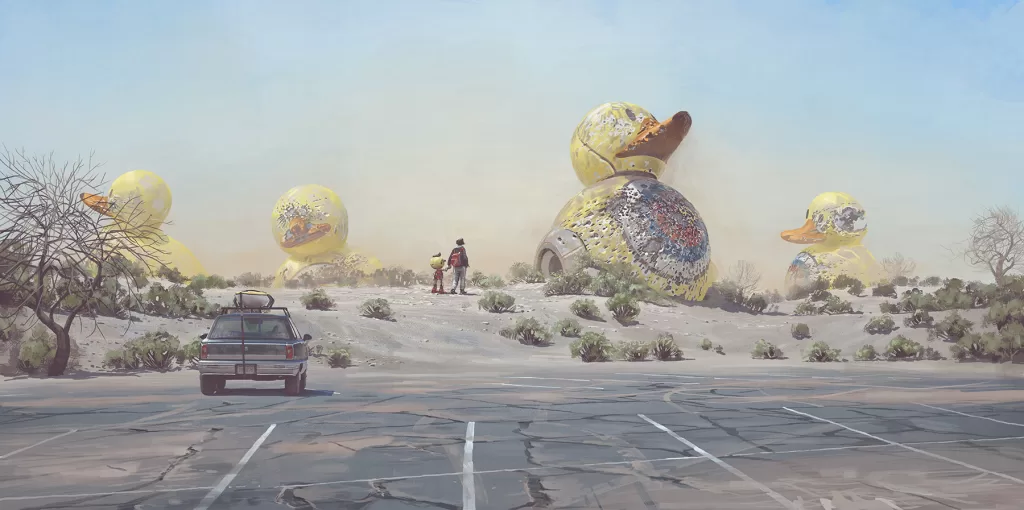
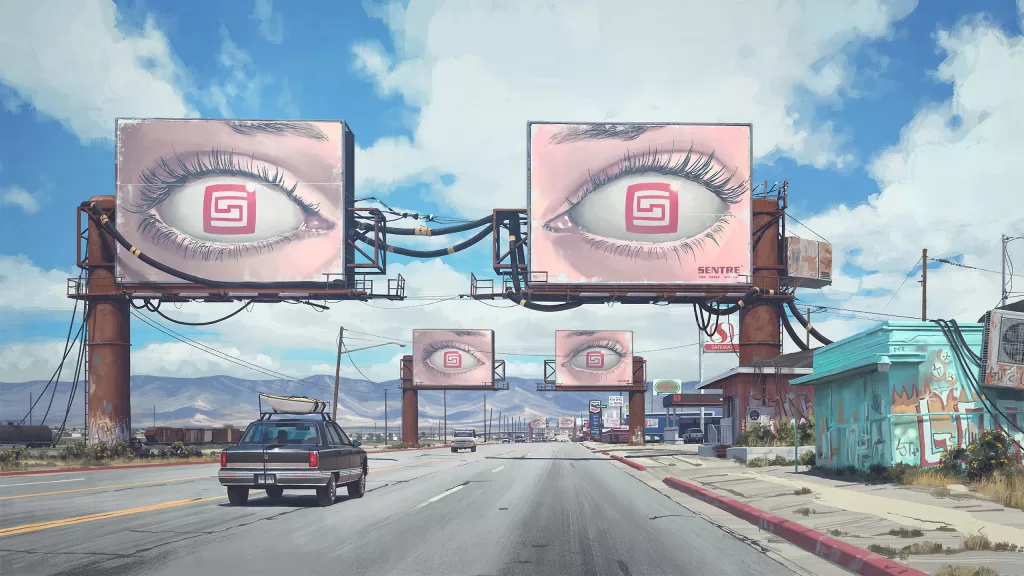
Imagine a dystopian world set in an alternative 1990s America. This world depicts an era where advanced technology pervades every corner, but society has collapsed. The electronic revolution manifests through large drones, abandoned robots, and mysterious, massive structures.
However, these technological advancements have brought chaos and collapse. Social structures have disintegrated, and the economic order has turned upside down. People have become isolated, cities have turned into ruins. Empty highways, abandoned homes, and apocalyptic landscapes are common sights. In this world dominated by electrical and digital structures, the cold and impersonal face of advanced technology deeply impacts human life.
Advanced drones and robots are now dysfunctional or abandoned. Buildings and cities, although equipped with technology, are devoid of life signs. This setting profoundly questions the human relationship with technology and the loneliness it brings. In short, it wouldn’t be wrong to call it a post-apocalyptic cyberpunk set in the ’90s.
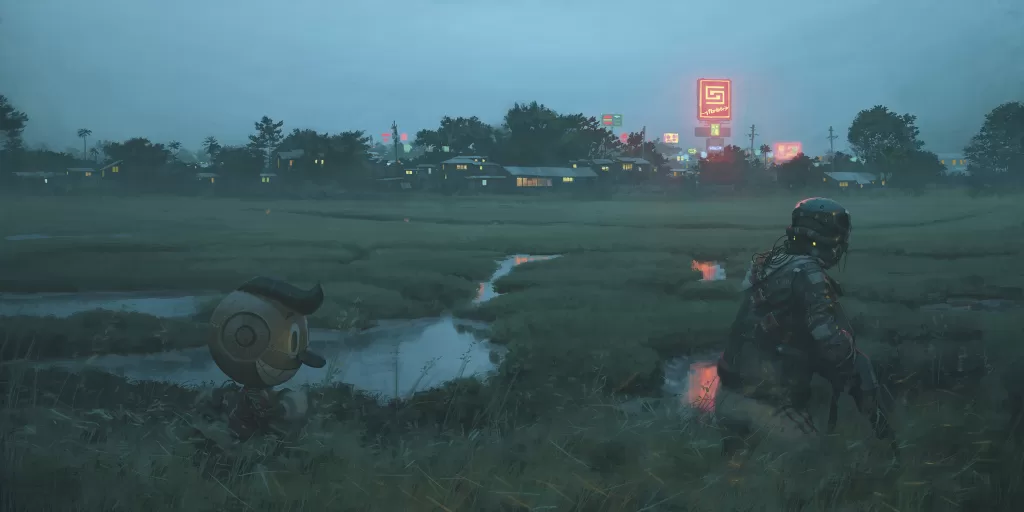
The most important thing to mention when describing the universe in detail is the Neurocasters. Neurocasters can be defined as a kind of VR (Virtual Reality) headset. Although they differ slightly in shape from today’s models, many of their other features are almost the same. However, these Neurocasters are irresistibly addictive. People use these casks to escape reality and do not remove them from their heads for days, not even to meet their basic needs, eventually dying from hunger or other reasons.
How Electric State RPG Works
The game primarily revolves around a journey. Each player is called a Traveler. Their goal is to travel from point A to point B in America. However, they need to stop at various locations during this journey. Each stop can be thought of as a one-shot adventure. To progress, you need to resolve the events at these stops. Some may involve a murder, while others may require rescuing a group attacked by addicts.
The book includes a prepared game with three stops called “Into the Dust.” You can use this for your first game, as I did, or create your own journey and stops using the recommendations and tables provided in the book.
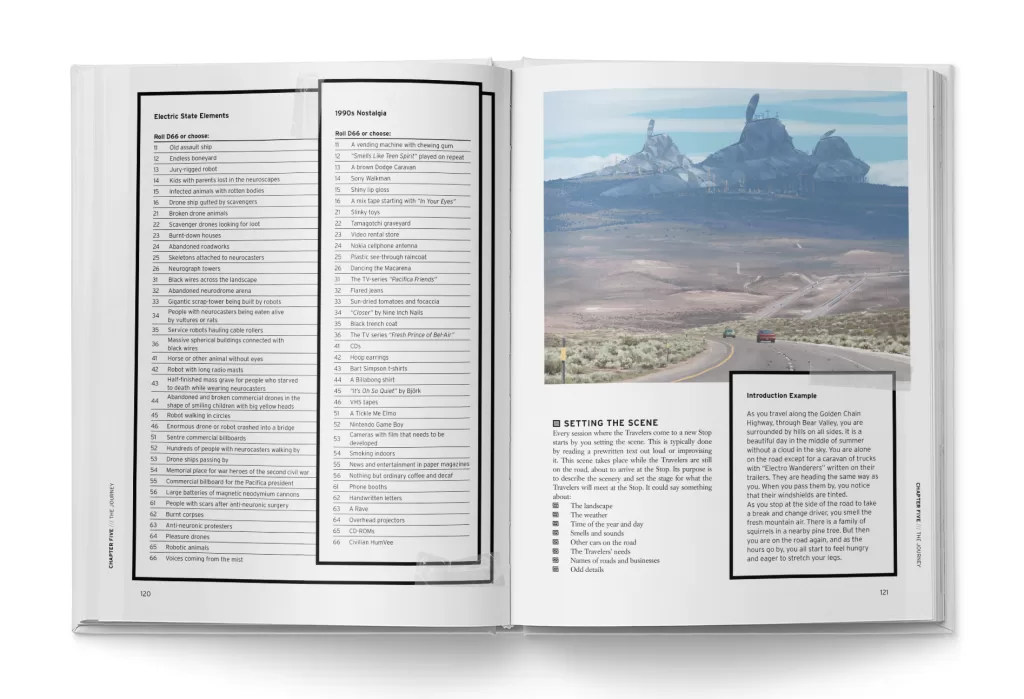
As the book states, remember that the journey itself is the goal, not the destination. In this game, you will be playing out a journey. It could be a short journey with 3-4 stops or a long journey with 12 stops. This is entirely up to you to decide. Whatever kind of journey you want to embark on, the book’s rich content allows you to do so.
Chapters of the Book
The book is 236 pages long and consists of 8 chapters. The first two chapters provide a detailed summary of the Electric State world and explain the basic principles of the game. How the world came to be this way, what the Neurocaster is, which companies exploit people, and many other things about the universe.
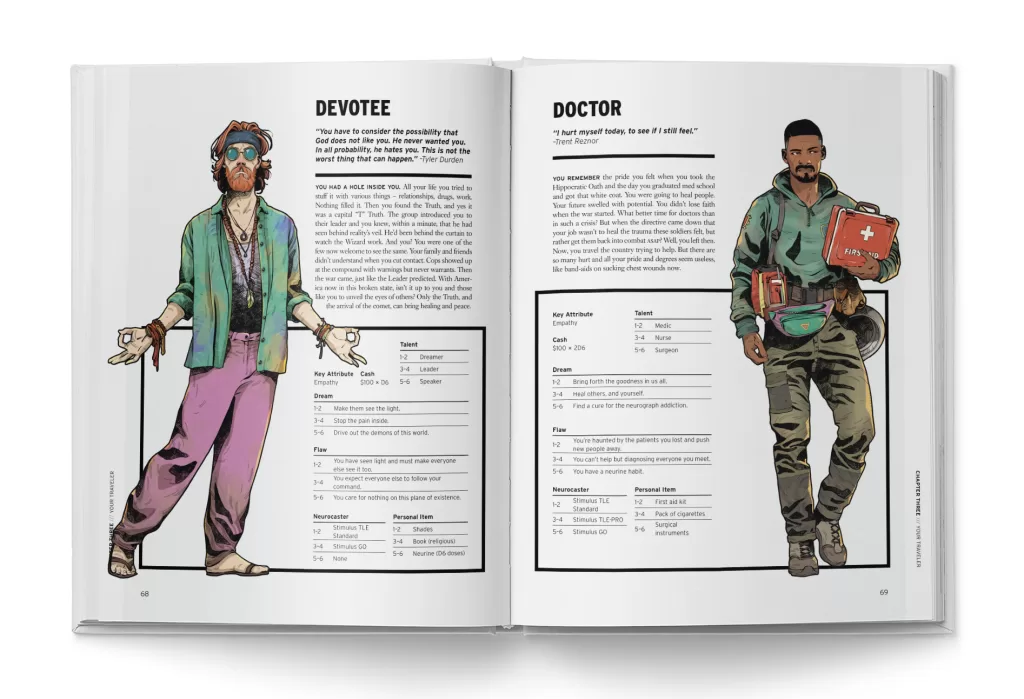
In Chapter 3, it explains how to create your Traveler, your character. There are 10 different Archetypes in this section, offering a wide range of options. The ones that caught my attention the most are the Drone Pilot and the Runaway Kid. If I ever manage to escape the curse of being a Game Master, I would love to try playing as one of these Archetypes.
The following Chapter 4 details the game’s combat system and other mechanics. (Year Zero Engine)
Chapter 5 reminded me once again why I love Free League. If you don’t want to play the pre-written story that comes with the book or if you’ve already played it and are looking for new adventures, you can use this chapter to write your own story and design your own journeys. This chapter provides a detailed guide on how to design your own journey, with dozens of different examples and recommendations. You can use just the tables to design a journey and the stops along the way, or you can review the examples and suggestions to create stories born from your own imagination.
The sixth section provides detailed information about every possible threat you can present to your players as a GM and explains how to use them in the game and how to create a different threat.
The seventh section contains a fantastic pre-made journey called “Into the Dust.” This journey consists of three stops and includes a series of missions written according to the archetype chosen by the players. I’ve run this journey twice, and both times it produced excellent results. The NPCs are detailed but written in a way that allows the GM to make their own interpretations, and the maps and character portraits add extra value when playing at the table.
The final section, the eighth, is written for those who want to play solo RPG. You can experience the game alone using the prepared tables and events. Recently, many people have started to turn to or try solo RPGs. By adding this to Electric State, Free League has contributed to the development of solo RPGs.
The Game System (Year Zero Engine)
As for the game system, it uses the classic Year Zero Engine but makes some minor additions. For those who don’t know what YZE is, let’s summarize it very simply in one sentence: you roll a six-sided die, and if you get a 6 or higher, you succeed. The system is basically this way, though it has details, but this is the main idea.
The game has four attribute points: Strength, Agility, Wits, and Empathy. All rolls are made based on these four values. To find our Health, we add Strength and Agility and divide by two, and to find our Hope points, we add Wits and Empathy and divide by two. But to explain what Hope is, we also need to explain the Bliss and Tension mechanics.
Hope, Bliss, and Tension Cycle
Hope represents a character’s mental health in the game. It can be thought of as the driving force that keeps them going on the journey. It can decrease or increase in certain situations. For example, the death of one of the fellow travelers can lower your Hope points. If your Hope points drop to zero, you experience a Breakdown and roll d66 to suffer one of the traumas on the Trauma table.
These traumas are not entirely negative; they can sometimes add different colors to the game. For instance, if you experience a personality split, you create a new character from scratch except for physical features, and you switch between characters whenever you lose Hope points. Playing two different roles with two characters at the table can sometimes lead to interesting sequences in the game.
So how do you increase your Hope points if they drop? There are actually several ways to do this. Spending time with your personal item, engaging in personal activities while resting, etc. But the most efficient way to increase Hope points is through Tension.
Tension represents the strength of your character’s feelings and emotions towards other characters. You can have 0, 1, or at most 2 Tension with any character. 0 means you have no feelings towards them, 1 represents suppressed or controlled strong emotions like anger, love, interest, or other feelings and thoughts, and 2 represents uncontrolled strong emotions like anger, love, or even fear.
If you have 1 Tension with any player, you can roll an extra die for any roll against them. To reduce Tension, you need to observe the events in the game and resolve the situation by talking and coming to an agreement with the character you have Tension with. Reducing your Tension with any character by 1 point gives you 1 Hope point.
You don’t always need to talk to that character to reduce Tension. Sometimes, events during the journey can lower your Tension towards them. The important point is that Tension and Hope progress in a certain balance. When your Hope points decrease, you need Tension to increase them again, but sometimes having Tension can also decrease your Hope points depending on the situation.
Tales From the Loop also had similar mechanical experiments, but here it is much more integrated into the system.”
Now let’s talk about Bliss. Bliss indicates how addicted you are to the virtual world while using the Neurocaster. If you need to roll a die while using the Neurocaster and you fail, your Bliss points may increase. Depending on the scenario, situation, or things you see in the virtual world, the game master may also ask you to increase your Bliss points.
If your Bliss points equal your Hope points, you become a Neurocaster addict and cannot remove the Neurocaster from your head voluntarily. Someone needs to do it forcibly, which can cause trauma.
Printing and Design Details
Unfortunately, the book hasn’t yet reached the distribution phase. This review was written thanks to the PDF provided to Kickstarter backers. However, a video of a pre-print version of the book was shared with Kickstarter backers.
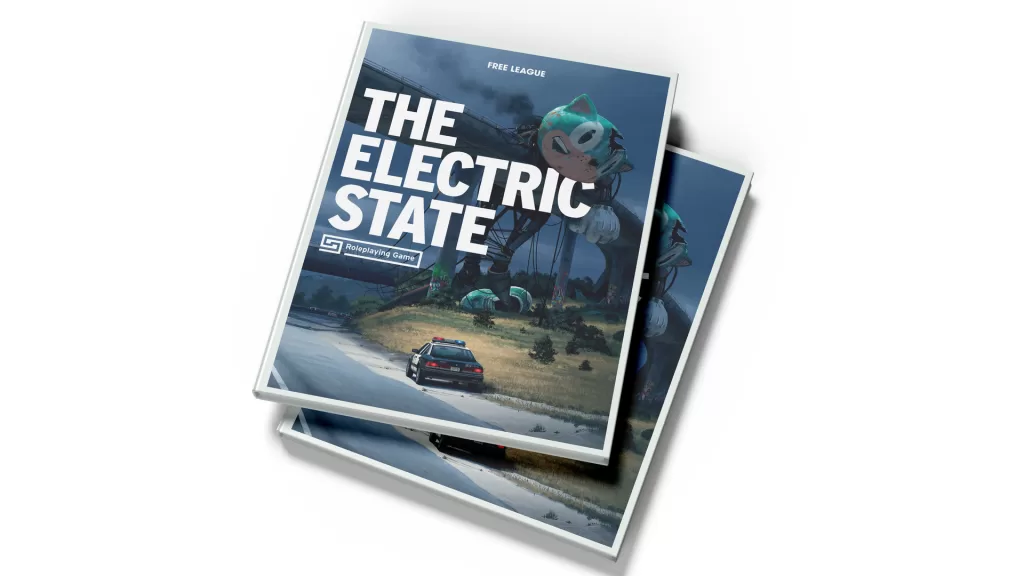
Honestly, one of the main reasons I supported Electric State was its excellent cover design. It’s quite simple yet effectively encapsulates the game’s theme, illustrating a world filled with meaningless materials due to its kitsch culture, and summarizing that you will embark on a journey with the players. The illustrations in the book are by Simon Stålenhag.
If you’ve read The Electric State, they will already be familiar to you. Honestly, I was happy to see the direct use of illustrations from the novel. Personally, I love Simon Stålenhag’s art style and want to encounter these illustrations as much as possible.
Additionally, the use of Trade Gothic Display 2 for the headings is likely to evoke the feel of road signs in America. After all, you are embarking on a journey in the game, and this should be reflected in the book. Choosing such an appropriate font for the headings reflects Free League’s long-standing expertise in book design. These thoughtfully considered details, in my opinion, elevate TTRPG books to a higher level. They transform them from simple rulebooks into products you’d want to display proudly on your shelf.
Conclusion
In summary, if the world of Electric State intrigues you and you’re looking to try something different from the usual RPG systems, Electric State RPG is a must-try. There likely won’t be another game this year that surpasses Electric State RPG. As we mentioned at the beginning of this article, Electric State RPG might be the best game Free League has produced so far.
Whether you experience this game as a player or a Game Master, once you leave the table, Electric State will undoubtedly become one of your favorite TTRPG systems. It might even take the top spot, just as it has for me.
Electric State RPG, with the unique world and atmosphere created by Simon Stålenhag, offers a one-of-a-kind experience for both newcomers and seasoned players. The game’s journey theme allows for diverse and unforgettable adventures at each stop. The detailed guidance and tools provided in the book let you design your own journeys, keeping the game fresh and exciting every time.
The game book, crafted with Free League’s years of experience, is not just about rules and stories but also a visual feast. Simon Stålenhag’s stunning illustrations and carefully chosen design elements make Electric State RPG a special addition to your collection. These details elevate the game beyond a simple rulebook, turning it into a piece of art you’ll want to display on your shelf.
In conclusion, Electric State RPG, with its depth, originality, and visual richness, is the most remarkable TTRPG of the year. Experiencing this game will take you on an unforgettable journey, both at the table and in your mind. If you’re searching for a unique and impactful RPG, Electric State RPG will exceed your expectations.